Shoulder Force
Overview
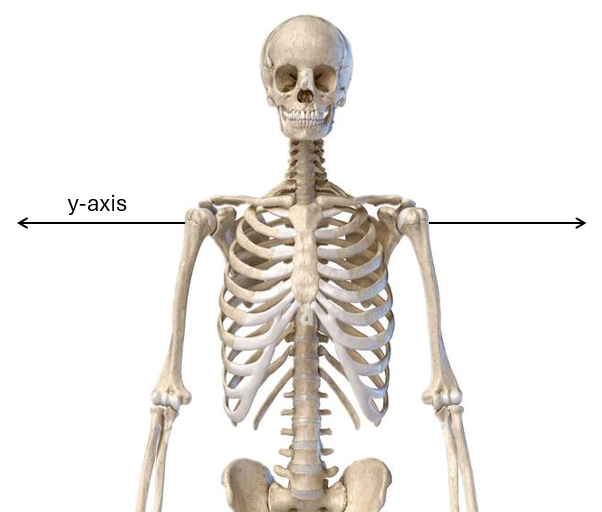
Shoulder Force refers to how much force the shoulder experiences laterally, or along the y axis, during a car crash event [1]. Evaluating and calculating shoulder force in ATDs helps improve vehicle safety, reduce injuries, and ensure that vehicles meet safety standards [2]. For example, seat belts, airbags, and seat structures can be optimized to reduce shoulder deflection and the likelihood of injury [2]. If the ATD used in testing has an established Injury Assessment Reference Value (IARV), the maximum shoulder lateral force is reported as a percentage of that IARV to indicate potential injury severity [3].
Required Signals
- Shoulder Force (Y)
Calculation
- Convert force signals to newtons (N) (if applicable)
- Filters the force signal (CFC = 600)
- Truncate force signal to start at 0 seconds (if applicable)
- Calculates the peak shoulder force and the corresponding time
- Calculates the percentage of the IARV threshold reached by the maximum force value
Shoulder Force IARV Table [4]
| ATD | IARV (N) |
|---|---|
| WorldSID | 2500 |
References
[1] Lebarbé, Matthieu & Potier, Pascal & Uriot, Jérôme & Baudrit, Pascal & Lafont, Denis & Douard, Richard. (2018). Human Shoulder Response to Lateral Impact in Intermediate Loading Conditions Between High-Velocity, Short-Duration and Low-Velocity, Long-Duration. Stapp car crash journal. 62. 319-357.
[2] U.S. Department of Transportation, National Highway Traffic Safety Administration. (2014). Federal motor vehicle safety standards; child restraint systems, child restraint systems—side impact protection, incorporation by reference. 49 CFR Part 571, Docket No. NHTSA-2014-0012, RIN 2127-AK95.
[3] "Frontal Offset Crashworthiness Evaluation - Guidelines for Rating Injury Measures" No. 2009-06. Insurance Institute for Highway Safety (IIHS), 2009.
[4] Petitjean A, Trosseille X, Praxl N, Hynd D, Irwin A. "Injury risk curves for the WorldSID 50th male dummy". Stapp Car Crash J. 2012 Oct; 56:323-47.