Mertz neck injury assessment
Description
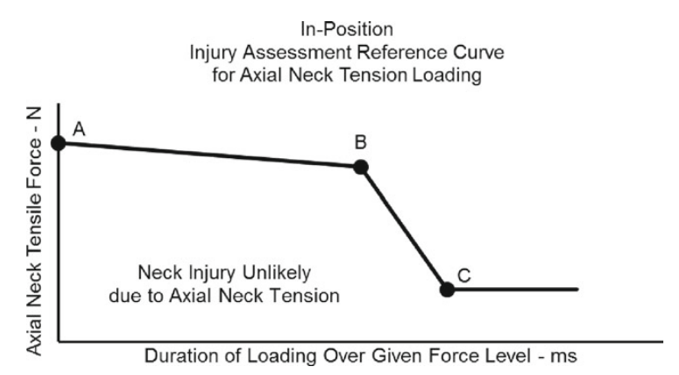
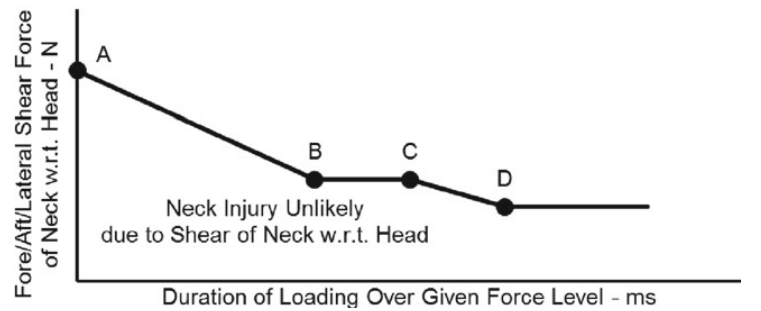
Mertz evaluates an individual neck force or bending-moment history against an ATD-specific injury assessment reference value (IARV). Force assessments account for both load magnitude and duration; bending moments use fixed flexion and extension limits [1] [2] [3].
When this feature is available
Mertz becomes available when either the current curve selection or any loaded test contains the upper-neck measurement required for the selected Neck Load Type. Only channels with a usable data status count.
The required measurement depends on the selected load type:
Shear Force: upper-neckX - LOCALforceAxial Force: upper-neckZ - LOCALforceBending Moment: upper-neckY - LOCALmomentBending MomentwithApply Moment Correctionselected: upper-neckY - LOCALmoment andX - LOCALforce
WebSAT checks each occupant or test subject independently. The button becomes available if any measurement set contains the inputs for the selected settings.
Settings
Neck Load TypeselectsShear Force,Axial Force, orBending Moment. The button label changes to show the selected load type.Apply Moment Correctioncorrects the bending moment to the occipital-condyle location. This option is selected by default and applies only toBending Moment. It requires the companion upper-neckX - LOCALforce.
How WebSAT processes the data
- Identify the load type and direction from the signal axis, units, and attachment.
- Convert the signal to the standard force or moment units.
- Apply the required impact-test filtering.
- If
Bending MomentandApply Moment Correctionare selected, correct the measured Y moment to the occipital-condyle location with the companion force channel. - Build the peak-versus-duration history for the processed signal.
- Compare every point with the applicable ATD-specific IARV curve or fixed moment limit.
- Report the governing load, duration, and maximum percent of the reference value.
Reference values and injury risk
Force-versus-duration curves
The force curves are piecewise linear between the listed time/load points. The coordinates are the Hybrid III-family IARVs published by Mertz, Irwin, and Prasad [1] [2]. Reference [1] is the corrected 2016 republication of the original 2003 paper. Positive loads represent tension or forward shear; compression values are negative. Only ATDs with populated curves can receive a force percent-IARV result.
| ATD | Tension curve: time (ms) → load (N) | Compression curve: time (ms) → load (N) | Shear curve: time (ms) → load (N) |
|---|---|---|---|
| Hybrid III 95th male | 0 → 5030; 38 → 4420; 49 → 1330 | 0 → -4830; 33 → -1330 | 0 → 3740; 27 → 1810; 38 → 1810; 49 → 1330 |
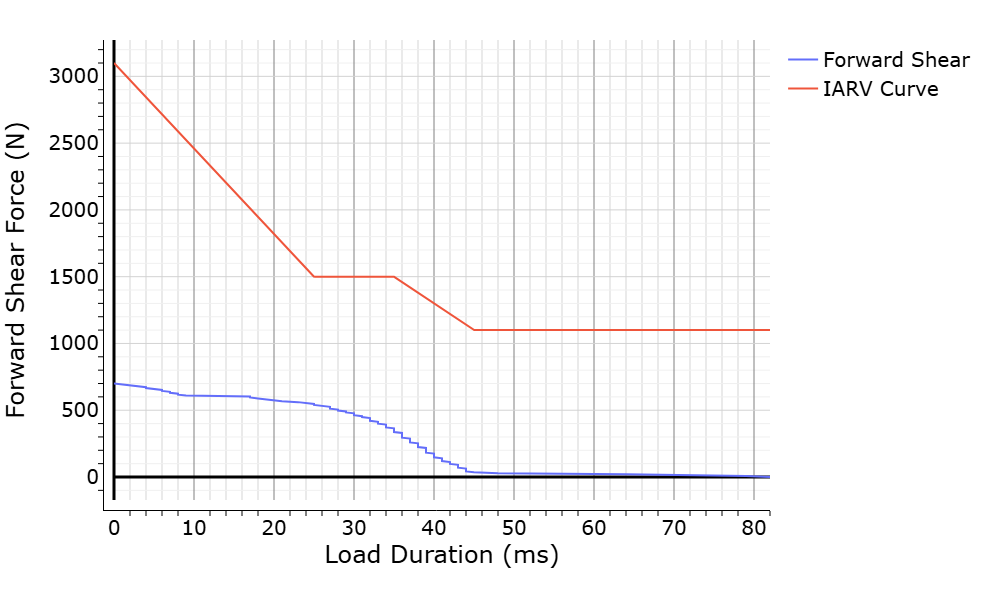
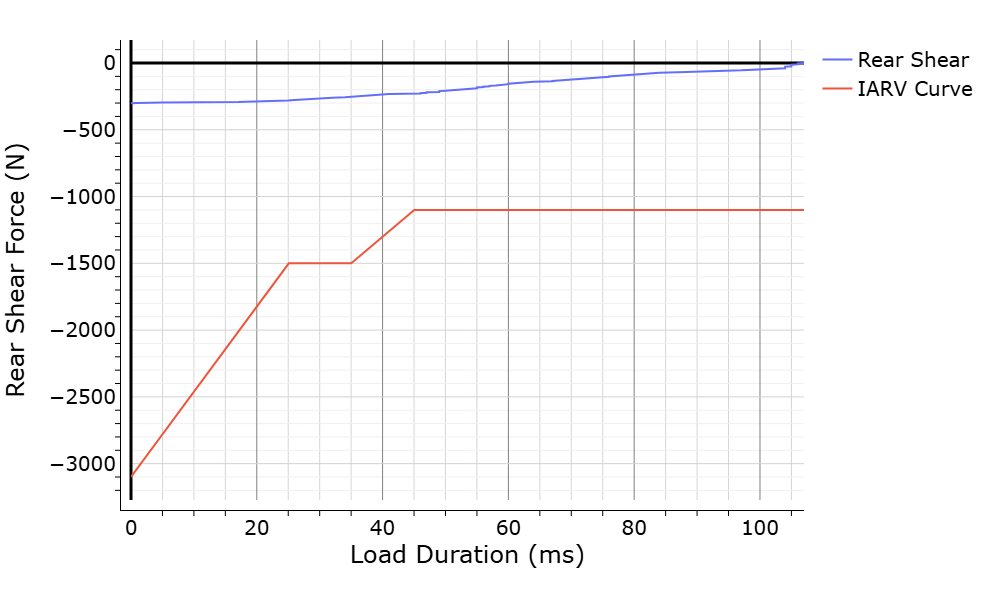
| Hybrid III 50th male | 0 → 3300; 35 → 2900; 45 → 1100 | 0 → -4000; 30 → -1100 | 0 → 3100; 25 → 1500; 35 → 1100 |
| Hybrid III 5th female | 0 → 2620; 28 → 2310; 36 → 690 | 0 → -2520; 24 → -690 | 0 → 1950; 20 → 950; 28 → 950; 36 → 690 |
Bending-moment limits
The fixed flexion and extension limits are from the same published ATD IARV framework [1] [2] [3].
| ATD | Flexion limit (N·m) | Extension limit (N·m) |
|---|---|---|
| Hybrid III 95th male | 252 | -128 |
| Hybrid III 50th male | 190 | -57 |
| Hybrid III 5th female | 95 | -49 |
| Hybrid III 10-year-old | 125 | -40 |
| Hybrid III 6-year-old | 60 | -30 |
| Hybrid III 3-year-old | 42 | -21 |
| CRABI 18-month | 29 | -15 |
| CRABI 12-month | 27 | -14 |
| CRABI 6-month | 25 | -13 |
| THOR 5th female | 88.1 | -94 |
| SID-IIs 5th female | 95 | -49 |
Mertz results are expressed as a percentage of the governing curve or moment limit. This function does not convert the result into an AIS probability.
Results
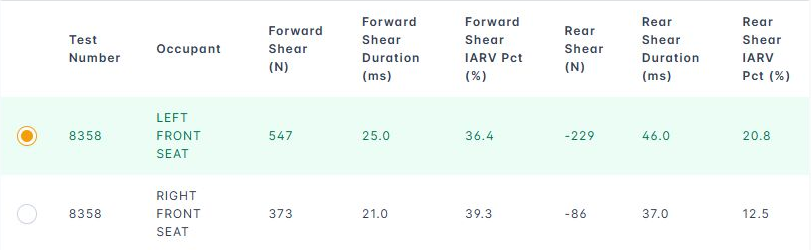
The summary identifies the test, occupant, load type, positive peak and duration, negative peak and duration, maximum percentage of the IARV curve, and the channel used. Supporting plots show the processed load and reference curve.
References
[1] Mertz, H. J., Irwin, A. L., and Prasad, P. “Biomechanical and Scaling Basis for Frontal and Side Impact Injury Assessment Reference Values.” 60th Stapp Car Crash Conference, 2016. SAE Technical Paper 2016-22-0018. https://doi.org/10.4271/2016-22-0018.
[2] Mertz, H. J., Irwin, A. L., and Prasad, P. “Biomechanical and Scaling Bases for Frontal and Side Impact Injury Assessment Reference Values.” 47th Stapp Car Crash Conference, 2003. SAE Technical Paper 2003-22-0009. https://doi.org/10.4271/2003-22-0009.
[3] Mertz, H. J. “Anthropomorphic Test Devices.” In Accidental Injury: Biomechanics and Prevention. Springer, 1993, pp. 66–84.