Brain Injury Criterion (BrIC)
Description
The Brain Injury Criterion (BrIC) uses peak head angular velocity about three axes to estimate the probability of brain injury. It complements acceleration-based measures such as HIC by representing rotational head motion [1].
When this feature is available
BrIC becomes available when either the current curve selection or any loaded test contains a head angular-velocity measurement set that meets the requirements. Only channels with a usable data status count.
The required measurement set includes:
- The signal attachment must be
HEAD CG. - The group must contain all three angular-velocity channels:
- Axis:
X - LOCAL, Units:DEGREES/SEC - Axis:
Y - LOCAL, Units:DEGREES/SEC - Axis:
Z - LOCAL, Units:DEGREES/SEC
- Axis:
WebSAT checks each occupant or test subject independently and enables BrIC if any HEAD CG group contains the complete three-axis set.
Settings
This feature has no settings.
How WebSAT processes the data
- Validate the complete X-, Y-, and Z-angular-velocity set at
HEAD CG. - Convert each angular-velocity component to radians per second.
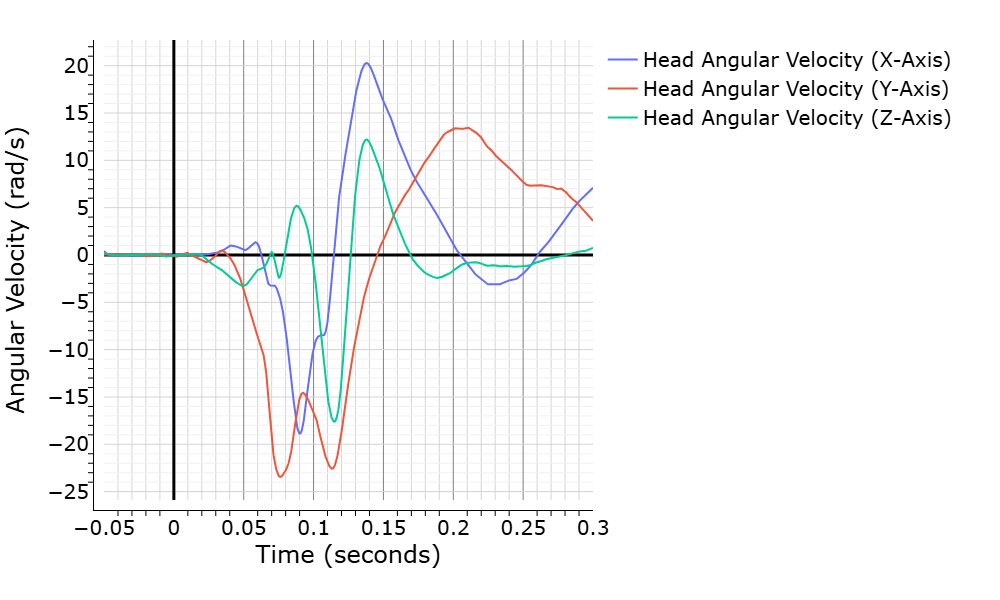
- Filter each component at CFC 60.
- Find the maximum absolute angular velocity about each axis.
- Normalize the three maxima by the BrIC critical velocities and calculate:
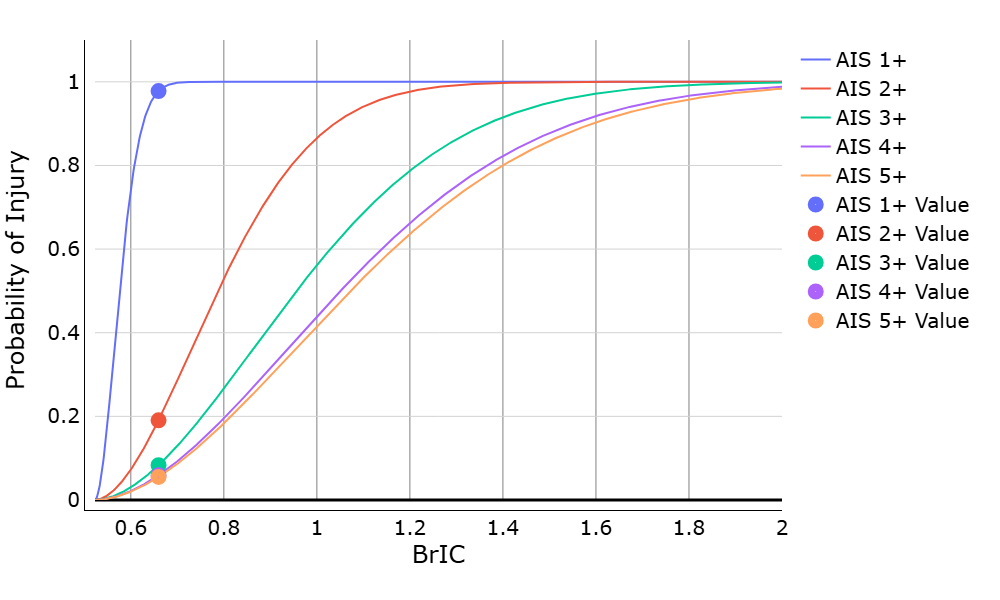
- Evaluate the AIS 1+ through AIS 5+ risk curves.
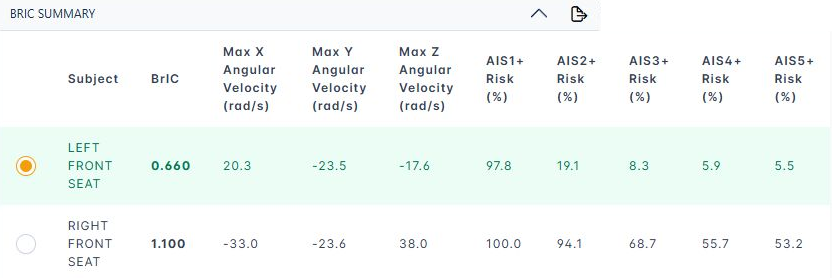
- Report BrIC, the component maxima, and the available injury probabilities.
Reference values and injury risk
BrIC is calculated by normalizing each peak angular velocity by a critical angular velocity. The values below are the critical velocities published with BrIC [1]:
| ATD | X critical velocity (rad/s) | Y critical velocity (rad/s) | Z critical velocity (rad/s) | BrIC reference value |
|---|---|---|---|---|
| Hybrid III 50th male | 66.25 | 56.45 | 42.87 | 1.05 |
| Hybrid III 5th female | 66.25 | 56.45 | 42.87 | 1.05 |
| THOR 50th male | 66.25 | 56.45 | 42.87 | 1.05 |
| ES-2re | 66.25 | 56.45 | 42.87 | 1.05 |
| EuroSID | 66.25 | 56.45 | 42.87 | 1.05 |
| WorldSID 50th male | 66.25 | 56.45 | 42.87 | — |
| Hybrid III 95th male with THOR-LX legs | 66.25 | 56.45 | 42.87 | — |
When the selected ATD does not define critical component velocities, WebSAT uses the default values 66.25 rad/s, 56.45 rad/s, and 42.87 rad/s for X, Y, and Z. The 1.05 values shown above are the populated ATD-level BrIC assessment references; the BrIC calculation itself is governed by the three component critical velocities.
The application reports risk for AIS 1+ through AIS 5+ using the BrIC cumulative-strain-damage relationships published by Takhounts et al. [1]. The supported curves share a lower location parameter of 0.523 and use AIS-specific scale parameters. The AIS 3+ and AIS 4+ relationships are:
Results
The result summary reports BrIC, the peak X/Y/Z angular velocities and their times, and AIS 1+ through AIS 5+ probabilities. Plots show the filtered component signals and risk curves.
References
[1] Takhounts, E. G., Craig, M. J., Moorhouse, K., McFadden, J., and Hasija, V. “Development of Brain Injury Criteria (BrIC).” Stapp Car Crash Journal, 57, 2013, pp. 243–266. https://doi.org/10.4271/2013-22-0010.