Thoracic Trauma Index (TTI)
Description
The Thoracic Trauma Index (TTI) combines lateral rib and lower-spine accelerations for side-impact assessment. WebSAT supports both ATD tests and cadaver/animal/human test informations, for which age and mass enter the normalized calculation [1] [2] [3].
When this feature is available
TTI becomes available when either the current curve selection or any loaded test contains a thorax measurement set that meets the requirements for the selected impact side. Only channels with a usable data status count.
The required measurement set includes:
- The same occupant or test subject must have all three required acceleration channels with:
- Axis:
Y - LOCAL - Units:
G'S
- Axis:
- The required attachments are:
- The upper rib on the selected
Impact Side - The lower rib on the selected
Impact Side SPINE - LOWER
- The upper rib on the selected
WebSAT checks each occupant or test subject independently and enables TTI if any measurement set contains the complete rib-and-spine channel set for the selected Impact Side.
Settings
| Setting | Default | Effect |
|---|---|---|
| Cadaver Age (Years) | 0 | Used for cadaver/animal/human records |
| Override Cadaver Age from Database? | Off | Uses the entered age instead of the saved test value |
| Cadaver Mass (kg) | 0 | Used for cadaver/animal/human records |
| Override Cadaver Mass from Database? | Off | Uses the entered mass instead of the saved test value |
| Impact Side | Left | Requires left- or right-side rib channels and applies the correct polarity |
| Skip Bias Removal | Off | Retains the original baseline during FIR100 processing |
Age and mass settings are ignored for ATDs.
How WebSAT processes the data
- Validate the upper-rib, lower-rib, and lower-spine acceleration channels for the selected
Impact Side. - Apply the FIR100 impact-test processing sequence to all three channels.
- Sign-adjust right-side signals so the calculation uses the expected positive impact direction.
- Find the governing upper- or lower-rib acceleration at each time sample.
- For an ATD, calculate:
- For cadaver, animal, or human data, apply the Eppinger and Kuppa normalization using the selected or database age and mass [2] [3].
- Find the peak TTI and record the component accelerations at that time.
- Report TTI, the component peaks, and the applicable reference values.
Reference values and injury risk
WebSAT uses a TTI injury limit of 85 g for four-door vehicles and 90 g for two-door vehicles, pickups, extended cabs, convertibles, and three-door hatchbacks [4].
The lower-spine component is also evaluated with a 3 ms clip when the selected ATD has a populated lower-spine reference value. The Hybrid III and side-impact-dummy values follow the published ATD IARVs and NHTSA side-impact criteria [3] [5]:
| ATD | Lower-spine 3 ms IARV (g) |
|---|---|
| Hybrid III 95th male | 54 |
| Hybrid III 50th male | 60 |
| Hybrid III 5th female | 60 |
| Hybrid III 10-year-old | 82 |
| Hybrid III 6-year-old | 60 |
| Hybrid III 3-year-old | 92 |
| EuroSID | 82 |
| WorldSID 50th male | 78 |
| SID-IIs 5th female | 82 |
| Hybrid III 95th male with THOR-LX legs | 73 |
| BioSID 50th male | 60 |
WebSAT reports the TTI limit, the lower-spine IARV, and percent of that IARV when available. TTI is reported as an index in g; this function does not convert the result into a separate AIS probability.
Results
The summary identifies the test, occupant/subject, age, mass, TTI, and the peak upper-rib, lower-rib, and lower-spine accelerations. Use these component peaks to confirm which rib channel governed.

This summary table shows the reported TTI result along with the associated test information and component peak values. It helps the user quickly review the governing accelerations, the reported TTI value, and the context needed to compare the result with the applicable reference values.
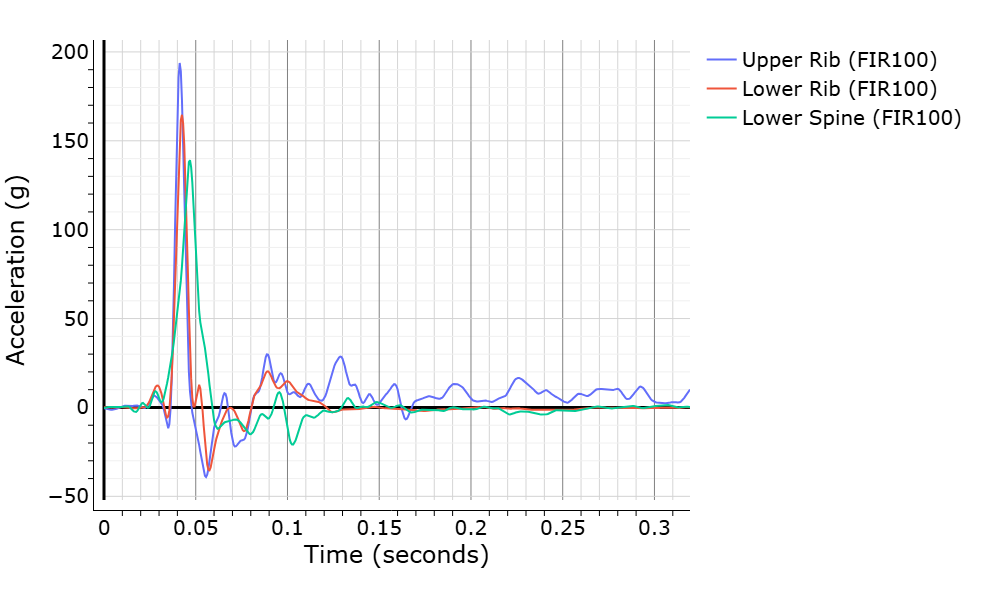
This plot shows the processed upper-rib, lower-rib, and lower-spine acceleration channels used in the TTI calculation. It helps the user verify the selected impact side, compare the relative magnitude of the rib channels, and see which rib response governs the TTI calculation.
References
[1] SAE International. Calculation Guidelines for Impact Testing. SAE Recommended Practice J1727.
[2] Eppinger, R. H., Marcus, J. H., and Morgan, R. M. “Development of Dummy and Injury Index for NHTSA's Thoracic Side Impact Protection Research Program.” SAE Transactions, 1984, pp. 359–387.
[3] Kuppa, S. Injury Criteria for Side Impact Dummies. National Transportation Biomechanics Research Center, National Highway Traffic Safety Administration, 2004.
[4] Trella, T. J. and Samaha, R. R. “Motor Vehicle Safety Standard 214 Side Impact Collision.” In Crashworthiness and Occupant Protection in Transportation Systems. ASME, 1995.
[5] Mertz, H. J., Irwin, A. L., and Prasad, P. “Biomechanical and Scaling Bases for Frontal and Side Impact Injury Assessment Reference Values.” Stapp Car Crash Journal, 47, 2003, pp. 155–188. SAE Technical Paper 2003-22-0009.