THOR 3D Deflection
Description
THOR 3D Deflection reconstructs thoracic motion from three-axis IR-TRACC displacement measurements and presents an interactive chest visualization. It also reports regional and overall resultant compression and, when applicable, THOR injury probabilities [1] [2].
When this feature is available
THOR 3D Deflection becomes available when either the current curve selection or any loaded test contains a chest measurement set that meets the requirements. Only channels with a usable data status count.
The required measurement set includes:
- The group must contain all three displacement channels at the same attachment:
- Axis:
X - LOCAL, Units: millimeters - Axis:
Y - LOCAL, Units: millimeters - Axis:
Z - LOCAL, Units: millimeters
- Axis:
- At least one complete three-axis set must be at the upper-left, upper-right, lower-left, or lower-right chest position.
- Abdominal positions can be included in the result when a qualifying chest set is also available, but abdominal curves do not make the button available by themselves.
WebSAT enables THOR 3D Deflection when any supported location contains the complete three-axis set. A complete four-point chest visualization requires valid data at all four chest IR-TRACC locations, so missing locations can limit the reconstruction even when the metric is available.
Settings
This feature has no settings.
How WebSAT processes the data
- Load the THOR geometry and the available chest and abdomen IR-TRACC channels.
- Convert the displacement inputs to consistent units and synchronize their time histories.
- Reconstruct each available sensor's joint-center position.
- Calculate X, Y, Z, and resultant displacement for each supported region.
- Find the maximum compression for every available chest region.
- Determine the overall Rmax value and its time.
- Evaluate abdominal X compression when both abdominal locations are available.
- Build the time states used by the interactive three-dimensional animation.
- Report the regional results, Rmax, available injury risks, and supporting visualization.
Reference values and injury risk
This function does not compare Rmax or abdominal compression with a fixed IARV. Instead, injury is expressed directly as an AIS 3+ probability using the THOR risk relationships [2]:
where and are in millimeters. The TIC relationship is applied to the maximum resultant chest deflection. The abdominal relationship is applied when the required abdominal X-displacement data are available. If the inputs do not support one of these assessments, its probability field is left blank rather than substituting a fixed limit.
Results
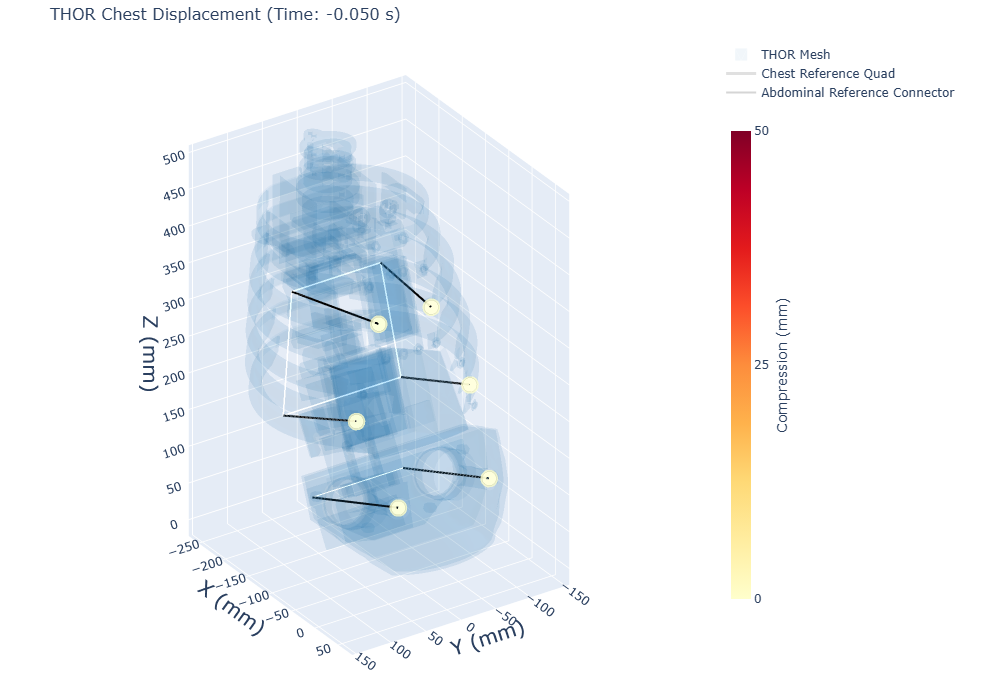
The summary includes Rmax, its time and region, regional X extrema and compression, abdominal compression when available, and supported AIS 3+ probabilities.
References
[1] Humanetics Innovative Solutions. 3D IR-TRACC THOR-50M User Manual.
[2] Craig, M. et al. Injury Criteria for the THOR 50th Male ATD. National Highway Traffic Safety Administration, 2020.