Tibia Index (TI)
Overview
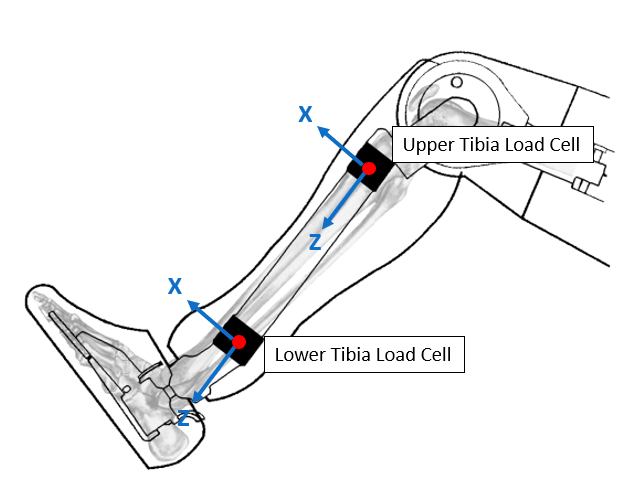
The Tibia Index (TI) injury metric uses A-P Moment (Y), L-M Moment (X), and Axial Force (Z) to understand the combined loading of compression and bending moment during frontal crashes. The leg has upper and lower tibia load cells that can be used to calculate TI.
Signals
- Tibia A-P Moment (Y)
- Tibia L-M Moment (X)
- Tibia Axial Force (Z)
Calculation
Calculation from SAE 1727 [1]
- Filter Tibia Force and Moment data (CFC = 600)
- Apply Tibia Moment Correction
- Calculate TI using Equation 1 [1]
Tibia Index Critical Values [2]
| ATD | (kN) | (N-m) |
|---|---|---|
| HIII - M95 | 44.1 | 306 |
| HIII - M50 | 35.9 | 225 |
| HIII - F05 | 22.9 | 114 |
References
[1] "Calculation Guideline for Impact Testing" No. J1727-2015-02 SAE International. SAE Technical Report, 2015.
[2] Mertz, Harold J. "Anthropomorphic test devices." Accidental injury: Biomechanics and prevention. New York, NY: Springer New York, 1993. 66-84.