Sacroiliac Joint Load
Overview
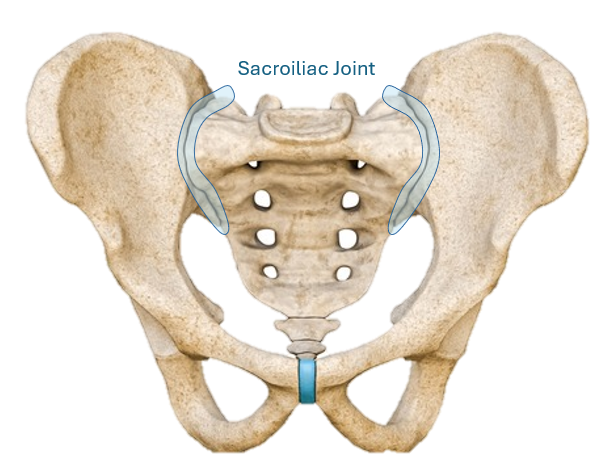
The sacroiliac joint plays a crucial role in transferring forces from the spine to the lower extremities [1]. If the sacroiliac joint is subjected to high levels of force, such as in a car crash, injuries like pelvic ring fractures or fractures in the sacroiliac joint itself may occur [2]. Additionally, if an Injury Assessment Reference Value (IARV) is associated with the Anthropomorphic Test Device (ATD) used in the selected load test, the calculated maximum sacroiliac force will be reported as a percentage of the IARV [3]. The IARV represents a threshold value used to assess the risk of injury during an impact. Each ATD has its own IARV, which varies depending on the type, sex, and size of the dummy [3].
Required Signals
- Force at the Middle Left Pelvis Iliac (X, Y, Z)
Calculation
- Convert each force signal to newtons (N) (if applicable)
- Filter the force signals (CFC = 600)
- Calculate the resultant force based on the filtered force signals
- Truncate to start at 0 seconds (if applicable)
- Finds the maximum resultant force
- Calculates the percent of the IARV threshold the calculated maximum resultant force reaches
References
[1] Kiapour A, Joukar A, Elgafy H, Erbulut DU, Agarwal AK, Goel VK. Biomechanics of the Sacroiliac Joint: Anatomy, Function, Biomechanics, Sexual Dimorphism, and Causes of Pain. Int J Spine Surg. 2020 Feb 10;14(Suppl 1):3-13.
[2] M. Tile, D. Helfet and J. Kellam, “Fractures of the Pelvis and Acetabulum,” 3rd Edition, Lippincott, Williams & Wilkins, Philadelphia, 2003.
[3] "Frontal Offset Crashworthiness Evaluation". Guidelines for Rating Injury Measures, Insurance Institute for Highway Safety, June 2009.