Acetabulum/Iliac Force
Description
This metric evaluates pelvis loading measured at the acetabulum and iliac load cells. WebSAT uses a combined lateral-force method for side-impact dummies and a resultant acetabulum-force method for THOR [1] [2] [3].
When this feature is available
Acetabulum/Iliac Force becomes available when either the current curve selection or any loaded test contains one of the required pelvis measurement sets. Only channels with a usable data status count.
WebSAT accepts one of these measurement sets:
- Side-impact path:
- Left or right acetabulum
Y - LOCALforce; and - Pelvis-iliac
Y - LOCALforce; and - Units
NEWTONSfor both channels.
- Left or right acetabulum
- THOR left path:
- Left acetabulum X-, Y-, and Z-local forces; and
- Left femur
Z - LOCALforce; and - Units
NEWTONSfor all four channels.
- THOR right path:
- Right acetabulum X-, Y-, and Z-local forces; and
- Right femur
Z - LOCALforce; and - Units
NEWTONSfor all four channels.
WebSAT selects the appropriate path from the occupant's ATD information and enables the metric if any eligible left- or right-side group satisfies that path.
Settings
This feature has no settings. WebSAT selects the path from the ATD information.
How WebSAT processes the data
- Select the side-impact or THOR calculation path from the occupant's ATD information.
- Convert the required force channels to newtons.
- Filter every force channel at CFC 600.
- For the side-impact path, sum the acetabulum and iliac Y forces at each time sample.
- For the THOR path, calculate resultant acetabulum force from the X, Y, and Z components.
- For the THOR path, suppress samples during femur tension so the result represents compressive hip loading.
- Find the governing combined or resultant force and its time.
- Report the result with the applicable IARV and injury risk when supported.
Reference values and injury risk
The supported SID-IIs combined-force IARV and AIS 3+ relationship come from the NHTSA side-impact requirements [4]:
where is combined pelvis force in newtons. For THOR, WebSAT uses the peak resultant acetabulum force in kilonewtons to calculate hip-fracture probability [5]:
WebSAT reports the risk only when the ATD has a supported relationship.
Results
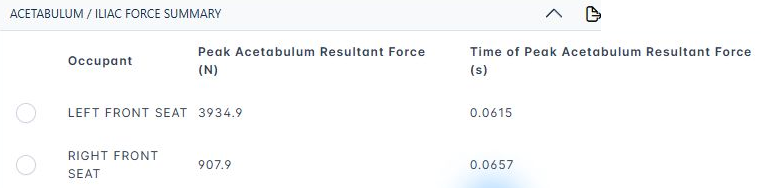
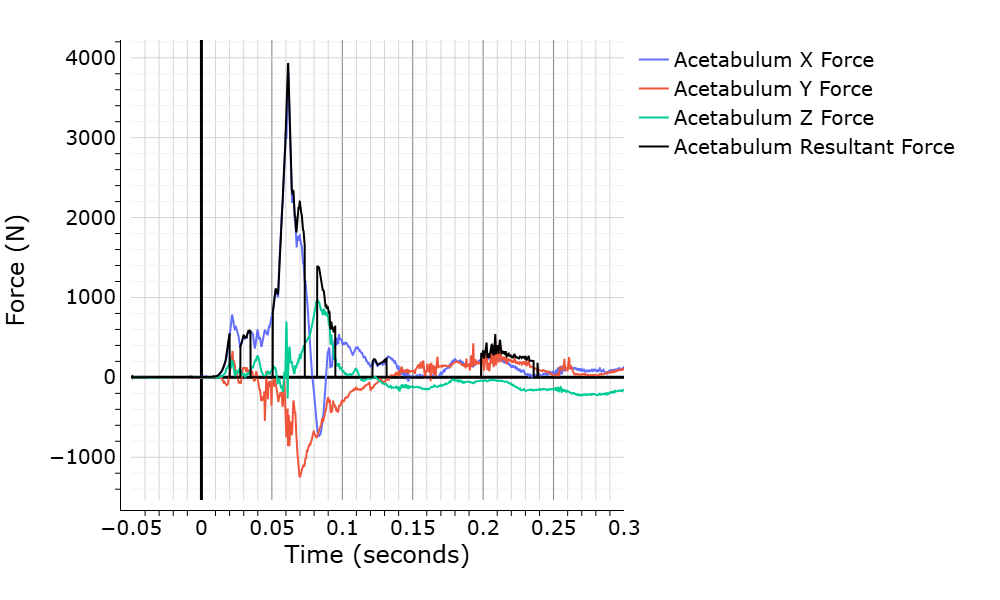
The result summary reports combined Y force and IARV information for the side-impact path, or resultant acetabulum force and hip-fracture probability for THOR. Supporting plots show the filtered component and combined/resultant curves.
References
[1] Zhu, J. Y., Cavanaugh, J. M., and King, A. I. “Pelvic Biomechanical Response and Padding Benefits in Side Impact Based on a Cadaveric Test Series.” SAE Technical Paper 933128, 1993.
[2] Bouquet, R. et al. “Pelvis Human Response to Lateral Impact.” 16th International Technical Conference on the Enhanced Safety of Vehicles, 1998.
[3] SAE International. Sign Convention for Vehicle Crash Testing. SAE Standard J1733, 2018.
[4] National Highway Traffic Safety Administration. 49 CFR § 571.214—Side Impact Protection.
[5] Craig, M. et al. Injury Criteria for the THOR 50th Male ATD. National Highway Traffic Safety Administration, 2020.