Pedestrian Hood Areas
Description
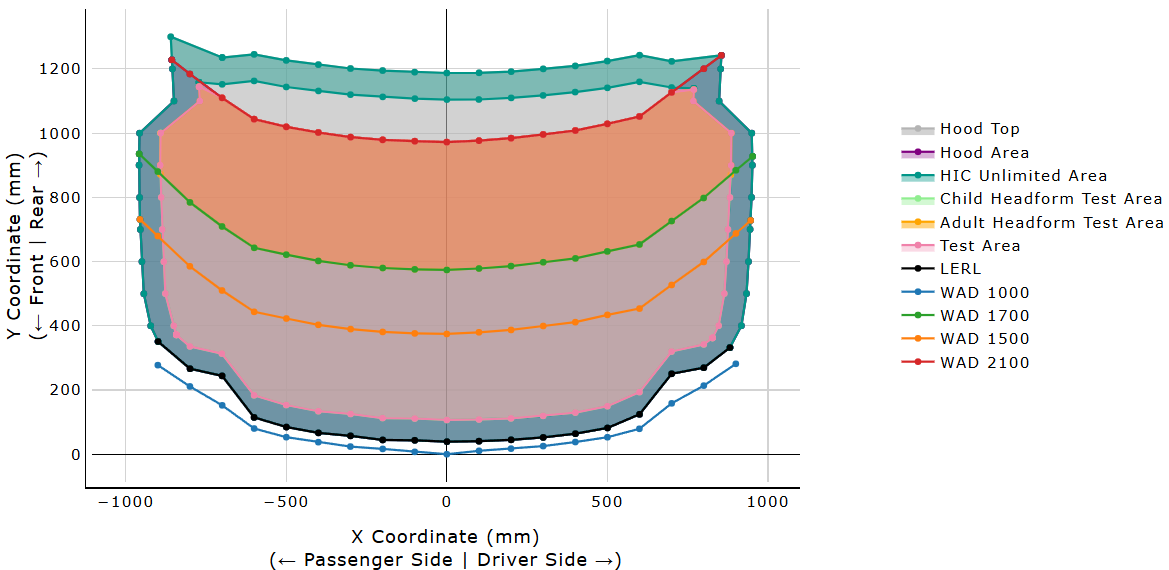
Pedestrian Hood Areas maps the hood regions defined by the proposed FMVSS No. 228 pedestrian head-protection requirements [1]. The proposal is based on UN Global Technical Regulation No. 9 and is adapted to United States conditions [2]. WebSAT shows six regions: Hood Top, Hood Area, HIC Unlimited Area, Child Headform Test Area, Adult Headform Test Area, and Test Area.
When this feature is available
Pedestrian Hood Areas becomes available when the active component test meets the requirements.
The active test must meet these conditions:
- The loaded test must be a component test.
- The title or test reference number must contain
FMVSS. - The loaded test must include at least one geometry entry.
- The loaded test must include at least one channel with a usable data status so WebSAT can associate the geometry with the test.
WebSAT enables Pedestrian Hood Areas from the loaded test information. You do not select curves for this feature.
Settings
This feature has no settings. WebSAT reads the geometry and vehicle information from the loaded test.
How WebSAT processes the data
- Load the available hood geometry and reference-line points.
- Construct the hood top from the leading-edge, side, and rear reference lines.
- Apply the HIC unlimited margins to the leading-edge, side, and rear reference lines.
- Create the geometric HIC-unlimited, child-headform, adult-headform, and combined test areas.
- Calculate each polygon's area with the shoelace formula:
- If an adult test area is not present, use the child area as the combined test area.
- Report the calculated areas and display the mapped hood regions.
How to interpret the results
This function does not calculate HIC or an injury probability. It prepares and reports the geometric regions used by the proposed pedestrian head-protection procedure [1].
Proposed HIC area requirements
- The manufacturer defines any HIC1700 area and supplies its boundaries for the compliance test. If the manufacturer does not define a HIC1700 area, the complete combined test area is treated as HIC1000.
- At least two-thirds of the Hood Area within the combined child and adult test area must be in the HIC1000 area.
- At least one-half of the Hood Area below WAD1700 within the child test area must be in the HIC1000 area.
- Any remaining test area must not exceed HIC1700.
- If two-thirds of the Hood Area is larger than the combined test area, the complete combined test area must meet HIC1000. No HIC1700 area is permitted.
- If there is no adult test area, the child test area becomes the complete test area and all tests use the child headform. Two-thirds of the Hood Area must meet HIC1000 within the child test area, and the remaining child test area must meet HIC1700.
Results
References
[1] National Highway Traffic Safety Administration. Notice of Proposed Rulemaking: Federal Motor Vehicle Safety Standards; Pedestrian Head Protection, Global Technical Regulation No. 9; Incorporation by Reference. 89 FR 76960, September 19, 2024.
[2] United Nations Economic Commission for Europe. UN Global Technical Regulation No. 9—Pedestrian Safety, 2009, as amended.