NCAP Star Ratings
Description
NCAP Star Ratings calculates NHTSA 5-Star Safety Ratings from loaded frontal, side moving-deformable-barrier (MDB), side pole, and optional rollover information. WebSAT converts occupant injury metrics to probabilities, combines them into relative-risk scores, and assigns one through five stars [1].
When this feature is available
NCAP Star Ratings becomes available when either the current curve selection or at least one loaded vehicle test has one of the required occupant measurement sets.
For a test group to pass:
- The loaded test must be a vehicle test.
- The group must satisfy one complete signal path:
- Frontal: both
LEFT FRONT SEATandRIGHT FRONT SEATmust have head X/Y/Z acceleration; upper-neck X and Z force and Y moment; chest X displacement; and left/right femur Z force. - Side pole:
LEFT FRONT SEATmust have head X/Y/Z acceleration plus pelvis-iliac and left acetabulum Y force. - Side MDB:
LEFT FRONT SEATmust have head X/Y/Z acceleration; left upper/middle/lower rib Y displacement; front/middle/rear abdomen Y force; and pubic-symphysis Y force. If aLEFT REAR SEAToccupant is present, that occupant must also have head X/Y/Z acceleration plus pelvis-iliac and left acetabulum Y force.
- Frontal: both
- For every path, acceleration must use
G'S, force must use newtons, displacement must use millimeters, and moment must use newton-meters at the named local axis. - The channels must use the expected accelerometer, load-cell, or displacement-transducer type and a usable data status.
- Head channels may be attached at
HEAD CGorHEAD 9 ARRAY - CENTER.
WebSAT evaluates the loaded vehicle tests by crash configuration and enables NCAP Star Ratings if any test contains the complete signal set required by its applicable path.
Settings
| Setting | Default | Effect |
|---|---|---|
| Primary Vehicle | Loaded vehicle | Identifies the vehicle being rated when multiple vehicles are present |
| Include Rollover | Off | Adds rollover and enables Overall Vehicle Score when all required crash modes are present |
| Drivetrain | UNSPECIFIED | AWD, 4WD, RWD, FWD, or unspecified |
| Static Stability Factor (SSF) | 1.3 | Input to rollover risk |
| Tip Status | NO TIP | TIP or NO TIP from the dynamic maneuver |
Rollover controls are used only when Include Rollover is on.
How WebSAT processes the data
- Associate the loaded frontal, side, pole, and rollover records with the selected vehicle.
- Identify the occupants and qualifying measurement sets required by each available rating mode.
- Calculate the required HIC, chest, femur, neck, rib, abdomen, and pelvis responses.
- Evaluate the applicable NCAP injury-risk function for each body-region response.
- For each occupant, combine the body-region probabilities:
- Normalize the joint probability to the NCAP fleet baseline to form a relative-risk score.
- Combine driver and passenger results for frontal and side ratings.
- Combine side MDB and pole results when both are available.
- Calculate rollover risk from SSF and tip status when requested.
- Calculate the Overall Vehicle Score when every required mode is available, weighting frontal, side, and rollover relative risk by
5/12,4/12, and3/12. - Report the available subratings, star ratings, and overall result.
Reference values and injury risk
NCAP uses the NHTSA injury-risk functions documented on the corresponding HIC, Nij/neck, chest deflection, femur force, abdomen force, rib deflection, pelvis force, and pubic-symphysis pages [3]. The rating thresholds applied to relative-risk score are defined by NHTSA's NCAP relative-risk method [2]:
| Relative-risk score | Stars |
|---|---|
| less than 0.67 | 5 |
| 0.67 to less than 1.00 | 4 |
| 1.00 to less than 1.33 | 3 |
| 1.33 to less than 2.67 | 2 |
| 2.67 or greater | 1 |
Rollover alone uses 5/4/3/2/1-star boundaries at 0.67, 1.33, 2.00, and 2.67 [2]. These are the thresholds that WebSAT applies. Compare the results with the protocol and model-year rules that govern the vehicle under study.
Results
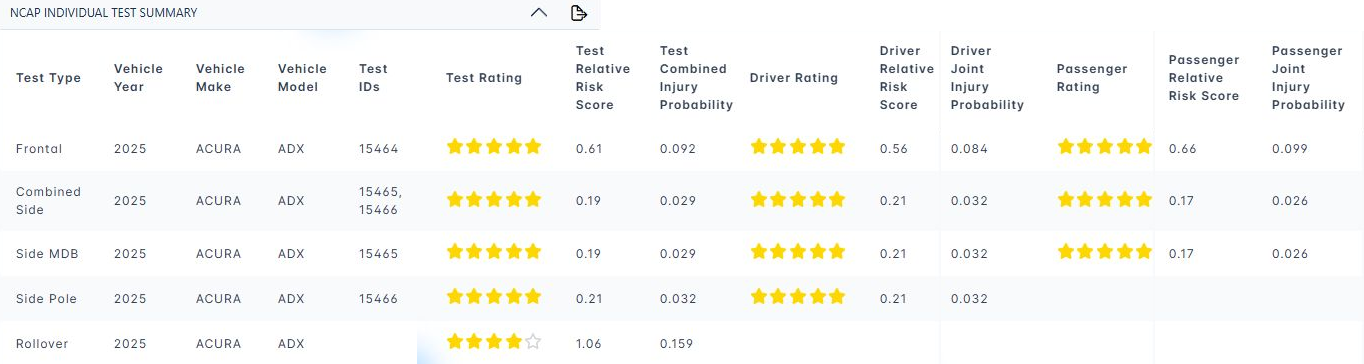
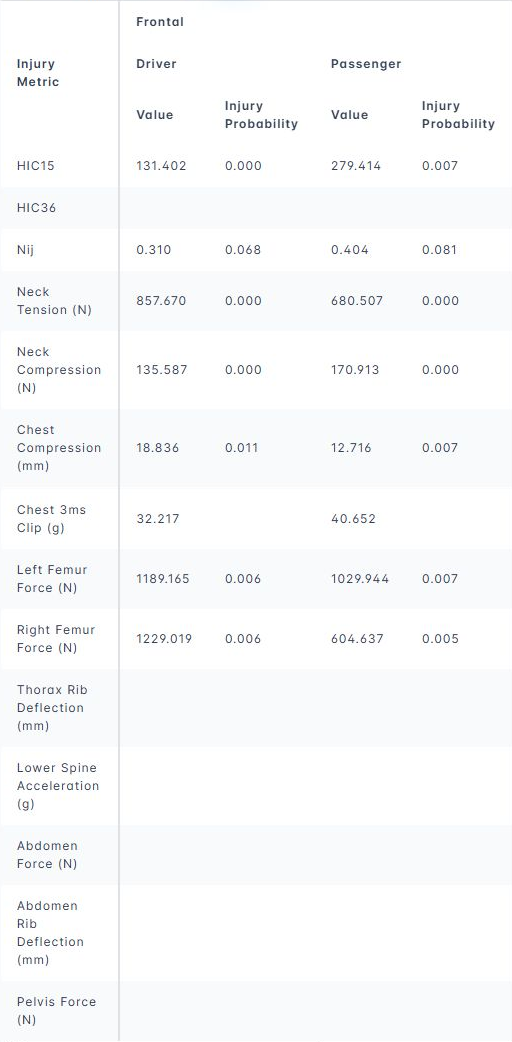
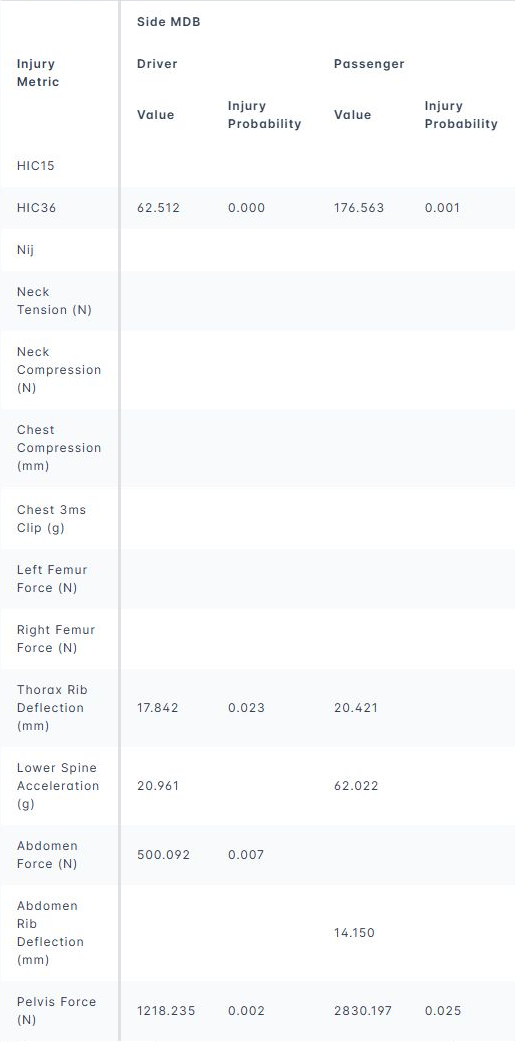
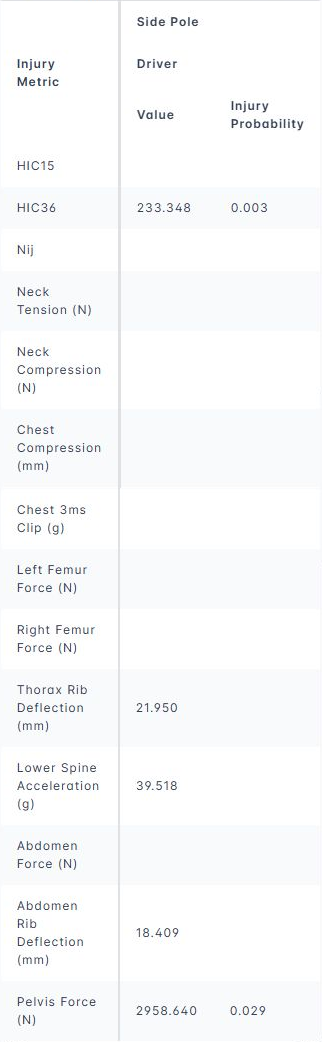
The result includes occupant-level injury probabilities and relative-risk scores, frontal driver/passenger and overall ratings, side MDB and pole ratings, combined side rating, rollover probability/rating when selected, and Overall Vehicle Score when complete.
The following tables show an example NCAP evaluation for a 2025 Acura ADX using test records 15464–15466.

References
[1] National Highway Traffic Safety Administration. Car Safety Ratings / 5-Star Safety Ratings, https://www.nhtsa.gov/ratings.
[2] National Highway Traffic Safety Administration. “New Car Assessment Program; Suggested Approaches for Enhancements.” Federal Register, 73 FR 40016, July 11, 2008, Appendix D.
[3] Eppinger, R. et al. Development of Improved Injury Criteria for the Assessment of Advanced Automotive Restraint Systems: II. National Highway Traffic Safety Administration, 2000.